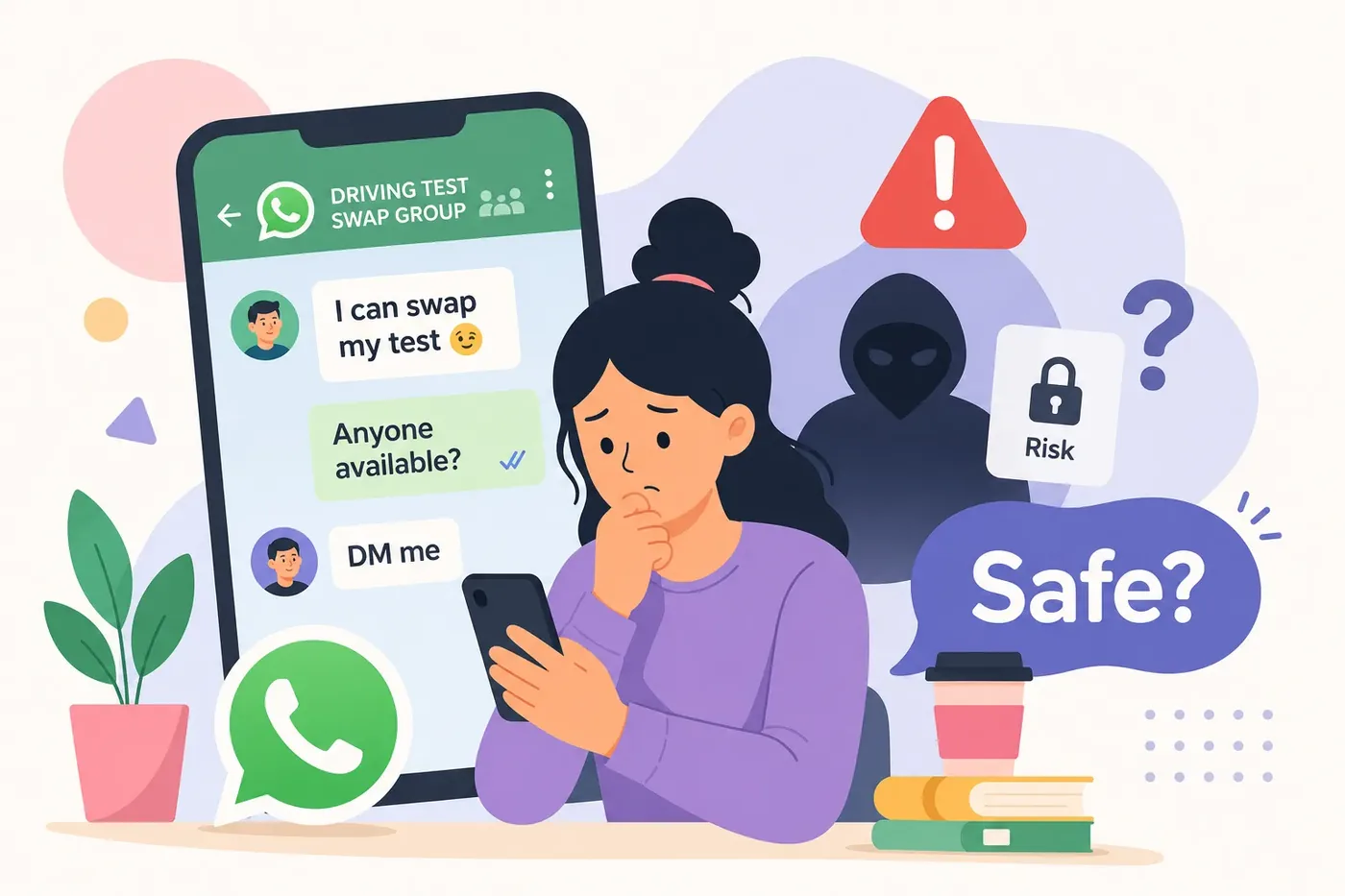
Driving test swap WhatsApp groups: are they safe? You've probably seen it: a WhatsApp group claiming to match learners who want to swap test dates. It looks convincing, real people, real slots, real urgency. If you're wondering whether it's safe to join a driving test swap WhatsApp group, the honest answer is that the evidence points firmly in one direction. The risks are real, documented, and consistent across multiple investigations. Understanding those risks, alongside the DVSA's rules and a practical way forward, is exactly what this article covers. Before we get there, it helps to understand the official rules, what investigators have actually found, and how to protect yourself if you're already looking for a date change. This covers the DVSA's position, the documented fraud, the privacy risks most learners never consider, and what safer alternatives actually look like.
What DVSA actually says about swapping your test date
The phone-only rule most learners don't know about
The DVSA's position is clear: swapping a practical driving test is legal between two learners, but it can only be processed by DVSA staff over the phone. Both learners must be available on the same call so staff can confirm identity and consent from each side. No online swap tool exists. No email route. No webchat. The DVSA has stated explicitly that you cannot use their WhatsApp account for this purpose. If anyone tells you otherwise, they are wrong.
The 10 working day rule and 2026 centre restrictions
Timing matters just as much as method. The swap request must be made at least 10 full working days before the date of the earliest test in the exchange. From 9 June 2026, an additional restriction applies: you can only swap to the same centre, one of the three nearest centres, or the centre where your test is currently booked. Third parties cannot complete the swap on your behalf. That means instructors, parents, and any website you find online are all excluded. The official change must come from the learner themselves, by phone, on a shared call with the other learner present.
Are driving test swap WhatsApp groups safe? What
documented investigations found
The BBC investigation and how the black market operates
The BBC's investigation, running across 2024 and into 2025, found that driving test touts were paying instructors up to £250 per month in exchange for their DVSA login credentials. Armed with those credentials, touts bulk-booked test slots and resold them via WhatsApp for up to £500. The official DVSA fee is £62 for a weekday test. The DVSA's own enforcement data backs up the scale of the problem: since January 2023, the agency has issued 283 warnings, 746 suspensions, and closed 689 businesses for misusing the booking service. Fake listings, payment fraud, and disappearing messages The fraud pattern on WhatsApp follows a recognisable script. Fraudsters advertise fake test slots on Facebook, move the conversation to WhatsApp, collect payment via bank transfer, then disappear. TSB documented victims who paid £350 through WhatsApp to fake DVSA websites and were immediately blocked. Which? investigated directly by joining one of these groups and found that admins used disappearing messages to share slot lists and redirect users to booking links. Those disappearing messages are not a technical quirk. They are a deliberate tactic to prevent any traceable record of the transaction.
The privacy risks that don't get talked about enough
What happens when your phone number is in a public group
Losing money is the obvious risk. The less discussed one is what happens to your phone number. When you join a public WhatsApp group, every member can see your number from the moment you enter. Group admins can download the full member list. That data can be sold, shared, or used as the basis for phishing attempts long after you've left the group. This is a structural feature of how public WhatsApp groups work, not a worst-case scenario.
What scammers do with your personal details beyond payment fraud
Data requests in these groups often go further than payment. Requests for driving licence numbers, theory test pass certificates, and email addresses are common. That information can then be used to send convincing phishing emails posing as the DVSA, to create fake accounts, or to book and cancel tests linked to your record. The DVSA has noted that WhatsApp accounts for 8% of fraud cases targeting learner drivers. This structural privacy problem is precisely what separates a dedicated matching service like Exchange Driving Tests from a public group. No phone numbers are ever publicly listed on the platform. Learners only need to provide a first name to register interest. The matching process is manual, and no contact details are shared until both learners have been separately confirmed and agreed to proceed. Is it safe to join a driving test swap WhatsApp group? Red flags to watch for Payment and communication warning signs Three payment methods appear consistently across driving test fraud cases: bank transfers, cryptocurrency, and gift cards. None offer any buyer protection, and payments going to accounts with random or unfamiliar names are another consistent pattern. On the communication side, watch for disappearing messages enabled in the group, sellers who approached you out of the blue via a direct message, and accounts that appear recently created with no verifiable history. These are not edge cases.
They are the standard operating pattern for this type of fraud.
Claims and data requests that should stop you immediately Some red flags are about what is being promised: slots available within days when official waiting times are running at months; guaranteed pass packages; VIP queue-jump access claiming inside connections to the DVSA. None of these things exist. Others are about what is being asked of you. Watch out in particular for requests for your gov.uk login password, your licence number, or your theory test pass certificate before any service is confirmed. A legitimate swap arrangement does not require your gov.uk password, and it does not require any payment. If either of those things is requested, that is the only signal you need. Safer ways to change your driving test date Exchange Driving Tests: how a privacy-first match works Exchange Driving Tests is a free, UK-based learner-to-learner matching service built specifically to avoid the risks described above. You register interest with your first name only. No phone numbers are publicly listed at any stage of the process. The matching is done manually, and both learners are contacted separately before any details are shared between them. Once a match is confirmed, the actual date change is completed through the DVSA phone line, the only official route in any case. The service works in both directions: if you want an earlier date, it looks for someone who needs more time; if you're not yet ready and want to move your date back, it looks for someone who needs your slot sooner. If you're not ready for your test, this is a safe, free way to find someone who needs your date. No payment. No data exposure. No public listings. Driving test cancellation alerts as a parallel option If you want an earlier date and haven't found a swap match, legitimate driving test cancellation alert services are worth knowing about. Services such as TestCancellations.co.uk and BookDrivingTest.uk automate the process of checking the gov.uk booking calendar for newly released slots. When one appears, they alert you so you can log in and book it yourself. Typical one-off fees run from £14 to £30. These services do not hold slots, do not guarantee results, and do not require your gov.uk password. When assessing any such service, look for verified Trustpilot reviews, transparent one-off pricing, and an absence of guaranteed outcome claims. Any service that promises a specific result is one to avoid. Already been caught out? Here's what to do Report to Action Fraud and your bank immediately If you have lost money, contact your bank first using the number on the back of your card. Then report to Action Fraud: online at actionfraud.police.uk or by calling 0300 123 2040, Monday to Friday between 8am and 8pm. If you are in Scotland, report to Police Scotland on 101 instead. When you report, include screenshots, the payment details you used, and any messages you received. Early reporting gives you the best chance of recovering funds through your bank's fraud protection process. Report the platform and verify your DVSA booking Report the specific content where you encountered the scam. On Facebook or Instagram, use the three- dot menu and select "Report." For suspicious websites, submit the URL to the National Cyber Security Centre. Forward phishing emails to report@phishing.gov.uk and text scams to 7726. Then go directly to gov.uk and confirm that your driving test booking is legitimately in the system. If anything looks wrong with your official record, contact DVSA via gov.uk/contact-dvsa to report it and request a correction. Public driving test swap WhatsApp groups carry real, documented risks. The privacy exposure is a structural problem with how these groups operate, not just an occasional scam risk. Your phone number becomes visible to every member the moment you join, and fraudsters in this space are sophisticated enough to use that data in ways that go well beyond a single payment fraud. For learners asking whether it's safe to join a driving test swap WhatsApp group, the practical answer is straightforward: there are safer options that carry none of the same exposure. A verified matching service like Exchange Driving Tests builds privacy into the process from the start; legitimate driving test cancellation alert tools offer a parallel route for those seeking an earlier slot without a swap partner. In both cases, the official DVSA phone line remains the only place where the actual date change happens. Knowing the rules and the risks puts you in control. You don't need to avoid changing your test date, you just need to use the right channels to do it.
