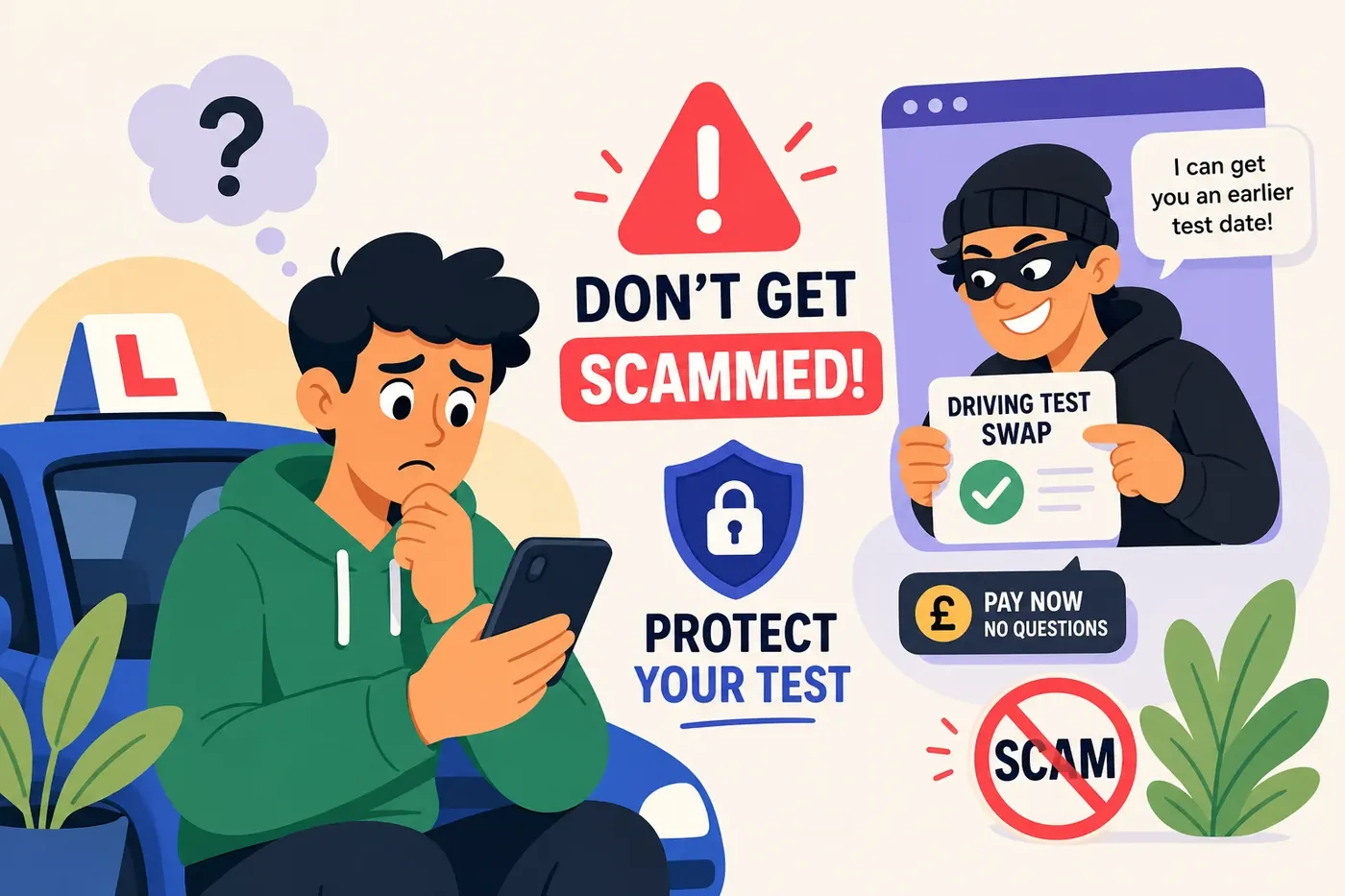
Stop if someone asks for these details
- Your DVSA or GOV.UK password.
- Your driving licence number or theory-test pass certificate number.
- Your full payment-card details or security code.
- Payment to “reserve”, “unlock” or buy a test slot.
- Remote access to your phone, email or booking account.
Common warning signs
- A guaranteed earlier test or a result promised within a precise time.
- Pressure to pay immediately by bank transfer, crypto or gift card.
- A social-media profile with no verifiable business identity or privacy notice.
- A link that imitates GOV.UK but uses another domain.
- A request to move the conversation into disappearing messages.
What a legitimate learner swap involves
Both learners already have a car test booked and each wants the other person’s exact slot. They check the timing, location, test-type, extra-time and remaining-change rules, then complete the official phone process themselves. The other learner needs only the booking-reference information specified by DVSA—not your licence number, address, email, password or card details.
Check any service before sharing data
DVSA does not approve or endorse cancellation finder apps. Its review of several unofficial services found gaps in the privacy notices it examined. A service should clearly identify who controls your data, why each field is needed, how long it is retained and how you can request deletion.
If you paid or shared information
- Contact your bank immediately using the number on its official website or the back of your card.
- Change any reused passwords and secure the affected email account.
- Check your booking directly through GOV.UK.
- Report financial fraud to Action Fraud in England, Wales or Northern Ireland, or Police Scotland in Scotland.
- Report suspicious emails, texts or websites through the National Cyber Security Centre.